
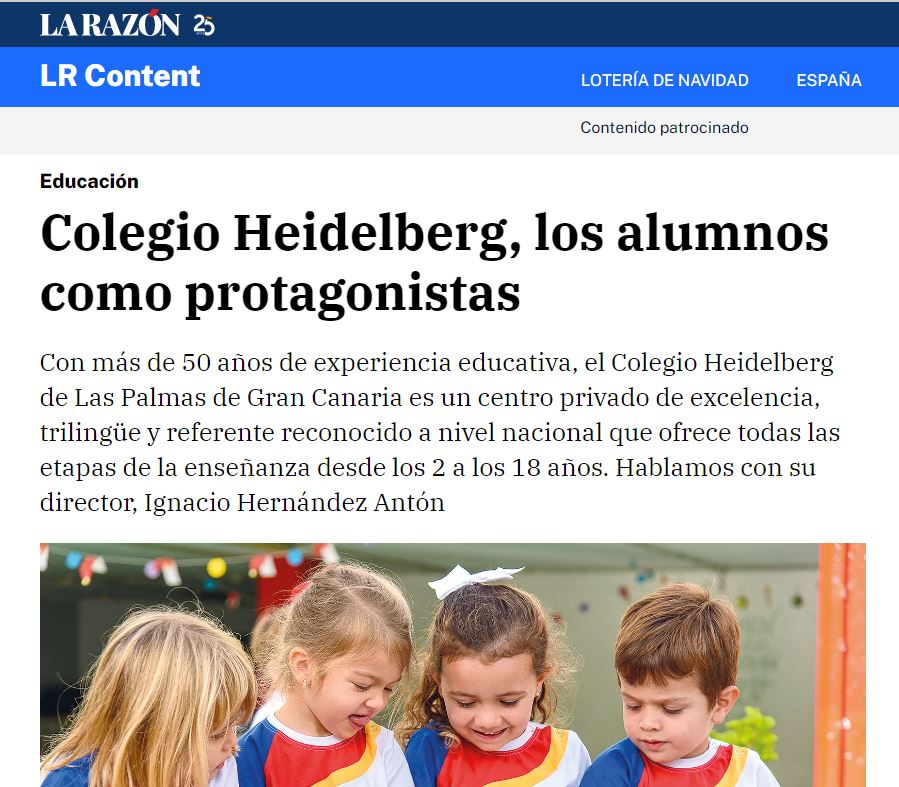
Heidelberg College, Students first
With over 50 years of educational experience, Heidelberg College in Las Palmas de Gran Canaria is a private center of excellence, trilingual and nationally recognized as a benchmark, offering all stages of education from ages 2 to 18. We spoke with its director, Ignacio Hernández Antón, ‘We believe in personalized education, and each student receives individualized attention.’
What is your assessment of the college’s trajectory?
We are grateful for the trust and recognition given to us by our families: 51 years of adapting to their needs, offering tangible results, and educating individuals with ethical values, principles, and skills to positively contribute to society. These years of experience have allowed us to refine an educational action where people come first.
What makes you different?
From an organizational standpoint, our unique participatory management system creates an environment of trust and fluid communication, resulting in great cohesion within the educational community. In fact, we reinvest all resources for the benefit of the project.
Pedagogically, one of our distinguishing features is interrelating different knowledge areas through projects that mobilize various cognitive and attitudinal resources. We believe in personalized education, where each student is individually tracked to design their learning path in collaboration with teachers, tutors, educational psychologists, and the pedagogical direction.
Regarding our educational team, professionalism, continuous training, diverse worldviews, and a deep educational vocation are common factors among all our faculty members. Our teachers’ stability allows for in-depth understanding of each student’s needs and trajectory. Few schools have as many educators awarded for educational innovation, competency assessment, active methodologies, and educational technologies. We are nonconformists, always asking how we can do better.
In what way?
All centers make efforts to coordinate their educational action at each stage, but at Heidelberg College, we go further: we think in terms of SX, Student Experience, that is, the sum of experiences each student has in their school life. In every decision, we consider the impact on the lives of students, teachers, and families.
Another difference lies in our students’ international projection through cultural immersion and language learning via a real and effective trilingual project, enabling students to reach a C1 level in both English and German. They start learning German at 2 years old and incorporate English studies from 5 years old. From Primary Education, foreign languages are used as vehicular languages for teaching other subjects.
Our extensive sports program is only possible with cutting-edge facilities and a professionalized sports club: football, basketball, volleyball, fencing, skating, judo, rugby, or artistic and rhythmic gymnastics. Students have access to the best trainers and specialists in physical activity.
How would you define the center’s educational project?
Our educational project is based on placing students as protagonists of all processes and people in the Center. This is realized in designing a differentiated curriculum where methodological variety, attention to different learning paces, stimulating learning situations, student involvement in their own development, coordination between stages, responsible use of educational technologies, and innovation in assessment and educational psychology processes stand out.
On the other hand, we apply a comprehensive approach to education, encompassing three fundamental areas of human development: intellectual, physical, and socio-emotional. Intellectual because we address the cognitive challenges of a highly digitalized environment, relying on active methodologies like project-based learning, Flipped Classroom, Thinking Based Learning, or Cooperative Learning; Socio-emotional because we take care of the development of social skills, emotional management, and values education; and Physical because sports and healthy habits are part of our curriculum.
‘Our educational project is based on placing students as protagonists of all processes and people in the Center.’
How is this strategy measured daily?
We perceive that our students enter the college every morning with enthusiasm, enjoy each learning experience, and come home eager to share what they have done at the center because they have fun learning. They enjoy a variety of activities that enrich their curriculum: visiting museums, natural spaces, attending auditions, participating in competitions, organizing charitable activities, caring for the environment, learning to socialize, and resolving differences through dialogue.
Our way of educating is also reflected in the results students achieve in external exams, both in the EBAU (an average score of 8.22 out of 10 in 2022) and in language certifications from Cambridge University, the Goethe-Institut, and the Deutsches Sprachdiplom der KMK.
How do families participate in Heidelberg College?
They help design and improve the educational project, actively collaborate in organizing many social, sports, and academic activities, such as graduations, performances, charity markets, or even in menu creation. Families are an active part of the teaching process and participate in craft and psychomotor workshops or in guidance talks for Secondary and Baccalaureate students. They are also the best hosts for new additions, welcoming new students and parents with the warmth typical of the Heidelberg family.
Is there room for innovation in education?
Yes, and it’s necessary. We’ve been doing it for over 50 years and continue to do so. Innovation based on educational research and constant reflection on teaching and learning processes is absolutely necessary for cutting-edge centers. The challenges of an increasingly complex, rich, and diverse society require educational institutions to be alert and respond to students and families. For us, innovating is not an obligation, it’s our DNA.»